Sunday, December 13, 2015

Class Reflection - Brian Brooks

I enjoyed Brian Brooks' lectures in the semester. Brian Brooks is our discussion instructor. He taught us how to exactly think global. He related his experience with principles of topics. For example, while our topic was globalization, he explained the definition and ideas of globalization by sharing his thoughts about other countries such as China. I was an international student coming from China. While our topic related to China, Brooks would ask me whether it was correct or not. I was very appreciated it. He showed the respect to us. Sometimes articles were about old China such as Asian Values, which I did not agree with it.


I remembered we have been discussed the political spectrum in class. Brooks drew a political spectrum on blackboard and asked students to write down countries’ name under the political spectrum on the basis of own knowledge. He didn’t punished students who wrote it wrong; instead, he would ask the reason for why he/she wrote it. If he thought that the answer was reasonable, he would not force students to change it. In addition, he was a knowledgeable instructor. He had lots of experiences and he would like to share with us. Sometimes he would share his ideas about what was going on at present. For example, he talked about recent event happened in Paris in our discussion. Even though it seemed not relate to the current topic we learnt, it was important to share our thoughts about the event. It was another way to encourage us to think global. 


I like Brooks' lecture very much. Sometimes he would show us some videos to explain his topics, which really helped us understand what was going on. I chose Costa Rica to be my region country, and I really enjoyed sharing my research on Costa Rica when I was doing the project. I enjoyed taking J3510 this semester. 

Sunday, December 6, 2015

Class Reflection


Guest Speaker Reflection


This semester has been packed full of guest speakers covering an incredibly wide range of topics and issues.  I have found many of the speakers to be very interesting,  from the talk on how drones will eventually change to world, to the outline of African American soldiers in Germany, it has been a very thought provoking fifteen weeks.  However, the speaker that I found to be most riveting was Professor Soren Larsen.  I could tell that he was very passionate about what was happening in Canada with the Cheslatta-Carrier Nation.  It was intriguing to learn about the culture of the group and the belief that places have "agency." Agency means that places are in essence held to the standards of a human being.  The                                                                                          
Cheslatta believe that our earth is very delicate and should be treated as such.  Agency can also be found at their cemeteries which are currently threatened by a Canadian aluminum company, Alcan (now known as Rio Tinton).  It is unfortunate that the Cheslatta nation has to deal with a major corporation that treats their culture with such little respect.  Yes, the company has given the society some financial help over the past few years, but the fact that they refuse to implement new technology to better control the flooding is somewhat disappointing.  However, I wanted to look at the other side of this issue which was not touched on in class.  Alcan is an international company that employs 68,000 people and is publicly traded on the New York Stock Exchange.  Does the  economic benefit that the company  provides for the world outweigh the interest of 330 individuals in an indigenous group?  The corporation had a net income of 7.24 billion in 2014 which allowed them to employ so many people.  One could argue that if it is making that kind of money; some of it should be spent on technology to better control the flooding.  But unfortunately it is not very feasible for Alcan as the company has consistently seen a decline in its stock price and revenues over the past five years.  Personally, I do not have a major opinion for either side of the issue.  The economic side of me makes me think that if a profit is being earned and people have jobs, let them do what they have to do, it is impossible to please everyone.  On the contrary,  the environmental/human rights side of me is saying that Alcan should stop all operations now!  The flooding of grave sites and displacement of a group is immoral. These contradictory beliefs lead me to be impartial on the issue.  Professor Soren was an interesting individual to listen to because of his passion for the issue and how much he had studied the group.  As you can tell from my lengthy rant on the Cheslatta Nation and Alcan I found him to be very challenging and ultimately very thought provoking.


Reflection on Cuba

In researching my country I gained so many insights.  Cuba has a fascinating history and is unexpectedly a very progressive nation.  Prior to studying Cuba the only thing I really pictured was a third world country with old run down buildings.  Little did I know that it is home to some of the most advanced cancer research in the world, and its scientists may be closer to finding a cure than anyone else.  I was also exposed to some of the brutal hardships Cuba is currently facing.  Poverty is very prevalent and human trafficking is a major problem.  Fidel Castro has been somewhat helpful in reducing poverty by revamping the education system, though the problem still exists.  Finally, I learned a great amount about the American embargo on Cuba and how it has impacted business in the country.  If the United States decides to lift the ban on trade, it may not be as beneficial to the citizens as we would like to believe.  I had little prior knowledge on the country of Cuba prior to studying it this semester, and I happy to have learned so much.


Overall I have thoroughly enjoyed this class. It has been a nice get away from the business school, and a great creative outlet with the bi weekly blog assignments.  It has been eye opening and has made me really want to study abroad.  The course has taught me that there is a big world out there, and to only focus on what is happening in the United States would be a shame.


Sources:

marketwatch.com    


Thursday, December 3, 2015

Brian Brooks

I enjoyed Brian Brooks’ lecture the most. He talked about the human rights issue and I personally found that most relevant to my life today and was most applicable to the world around us. Compared to some of the other lecturers, I think this was the easiest to listen to and keep focus on because this topic applies to everyone. I thought it made people think about everything going around them and the problems our world is facing today.

            Brooks defined human rights as rights you have simply because you’re human. These rights apply to everyone, everywhere. Although they don’t always apply to everyone, they’re supposed to. We shouldn’t treat others as if they’re less than us simply because of their race, color of their skin, where they live, where they came from or where they work. This is especially topical today because of everything happening at The University of Missouri. We talked about it in class a little, but if people honestly feel as if their human rights are being threatened, something should be done about it. The human rights vary from rights such as the first, “We are all free and equal”, to “workers rights” and even to “the right to relax”. Although some seem more important than others, they are all still our basic human rights that each individual person is supposed to have. 
                                

            One of the human rights is that nobody has a right to take away these rights and freedoms, and I feel as if in today’s world these rights are very much threatened, especially in certain countries. We may not hear about them or they may not be on the front page in a newspaper but they still are happening all around us and we need to be aware of them.


            I learned a lot about the Dominican Republic. I feel as if many people don’t know a lot about this country, as I didn’t know much before this class. I learned there are more problems there than meets the eye. When we had to pick an NGO, I picked Operation DREAM, which helps kids achieve the education that their human rights give them. In my life, education is a given. Where I grew up everyone went to kindergarten, everyone graduated 8th grade, everyone made it to high school and graduated and went on to prestigious schools such as Notre Dame, Indiana University, Cornell, Stanford, etc. Point is, we all were given the opportunity to go to school from our parents. However, in the Dominican Republic these kids don’t have the same opportunity. It was definitely an eye opening experience to follow this country throughout the semester.

Monday, November 23, 2015

Politics of the Veil

Amy Novotny
14172530
Politics of the Veil:

1.     Despite reservations about the headscarf, the political scientist Mossuz-Lavau argues against the law to ban headscarves. What is at the crux of her argument? Is it valid? (162)
a.      She says she was deprived of the sexual liberation that was hers by right.

2.     What are the implications when we talk about bringing Muslim women up to the standard of their French sisters (or western sisters)? (172)
a.      They said that By rising up against foreign signs of sexism, doesn’t our society prove that it wont tolerate sexism? The conclusive evidence of the inassimilability of Muslims was the difference of their approach to sex and sexuality.

3.     How does the author come to the conclusion that “rather than resolving the problem of integrating Muslims into French society, the law banning headscarves has exacerbated it”? (179)

a.      Because it is saying the problems are still there. Women still aren’t getting jobs from it. Women are still being treated differently. The example given about the woman at the bank and how a teller refused to wait on her is simply sad, but it shows the problem is still there.

Sunday, November 22, 2015

Politics of the Veil - answer a question

Despite reservations about the headscarf, the political scientist Mossuz-Lavau argues against the law to ban headscarves. What is at the crux of her argument?


The feminist political scientist Mossuz-Lavau argues against the law to ban headscarves because she thinks that the government should not force Muslim women to wear the headscarf. Muslim women have their rights to design whether they could put the headscarf on or not. According to the article Politics of Veil, Janine Mossuz-Lavau wrote an appeal against the law. “When I pass a woman with a veil in the street. I feel a pang of emotion.” She thinks that the veil designated the woman as “a source of sin,” and “as a potential whore.” She thought that it deprived as she was of the sexual liberation that was hers by rights. Mossuz-Lavau then cited a study she had done in 2000-2001 of sexual practices in French society. She did interviews on women and found that if the test of liberation were sexual freedom, she concluded that the girls with headscarves must be allowed to stay in school.

Sunday, November 15, 2015

Human Trafficking in Guatemala

According to the U.S. State Dept Trafficking in Persons Report in June 2009, Guatemala is a source, transit, and destination country for Guatemalans and Central Americans trafficked for the purposes of commercial sexual exploitation and forced labor. Human trafficking is a significant and growing problem in the country, particularly the exploitation of children in prostitution.

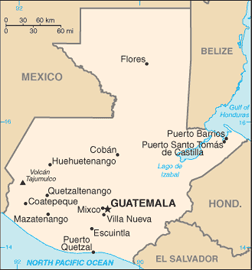
Guatemala is the most populous of the Central American countries with a GDP per capita roughly one-half that of Argentina, Brazil, and Chile. (Credit: gvnet.com)

Human trafficking is one of the most significant and growing problem in the country, particularly the exploitation of children in prostitution. Guatemalan women and children are trafficked within the country, and to Mexico and the United States, for commercial sexual exploitation.

According to the report, young Guatemalan girls are also subject to forced labor within the country as domestic servants. Guatemalan men, women, and children are trafficked within the country, as well as to Mexico and the United States, for forced labor, particularly in agriculture. In the Mexican border area, Guatemalan children are exploited for forced begging on streets and forced labor in municipal dumps; Guatemalan men, women, and children are trafficked for forced agricultural work, particularly on coffee plantations.

Migrants from Guatemala stream into the United States by way of human trafficking networks through Mexico. (Credit: Reuters)

With the Sustainable Development Goals (SDGs) which come into effect in 2016. Human trafficking is addressed by one of the goals. In Goal 5. Achieve gender equality and empower all women and girls, it suggests in 5.2 that to "eliminate all forms of violence against all women and girls in public and private spheres, including trafficking and sexual and other types of exploitation". And in Goal 16. Promote peaceful and inclusive societies for sustainable development, provide access to justice for all and build effective, accountable and inclusive institutions at all levels , it says in 16.2 to, "end abuse, exploitation, trafficking and all forms of violence and torture against children."

A South Asian-Central American human trafficking network that traffic people illegally to the U.S. through Guatemala. The illegal migrants were flown mostly from Delhi, Amritsar and Ahmedabad in India through Istanbul and then on to Guatemala. They later entered the U.S. illegally over land from Mexico. (Credit: India Times)

There are lots of things to be done to prevent human trafficking. for instance, implement and enforce the new anti-trafficking law; increase efforts to investigate and prosecute trafficking offenses, and convict and punish trafficking offenders, including public officials complicit with trafficking activity; pursue suspected cases of forced labor and domestic servitude crimes in addition to suspected cases of adult sex trafficking; improve victim services and assistance; increase anti-trafficking training for judges and police; and increase funding for anti-trafficking efforts, particularly for the country’s dedicated prosecutorial and police units, which are suggested by the Persons Report